
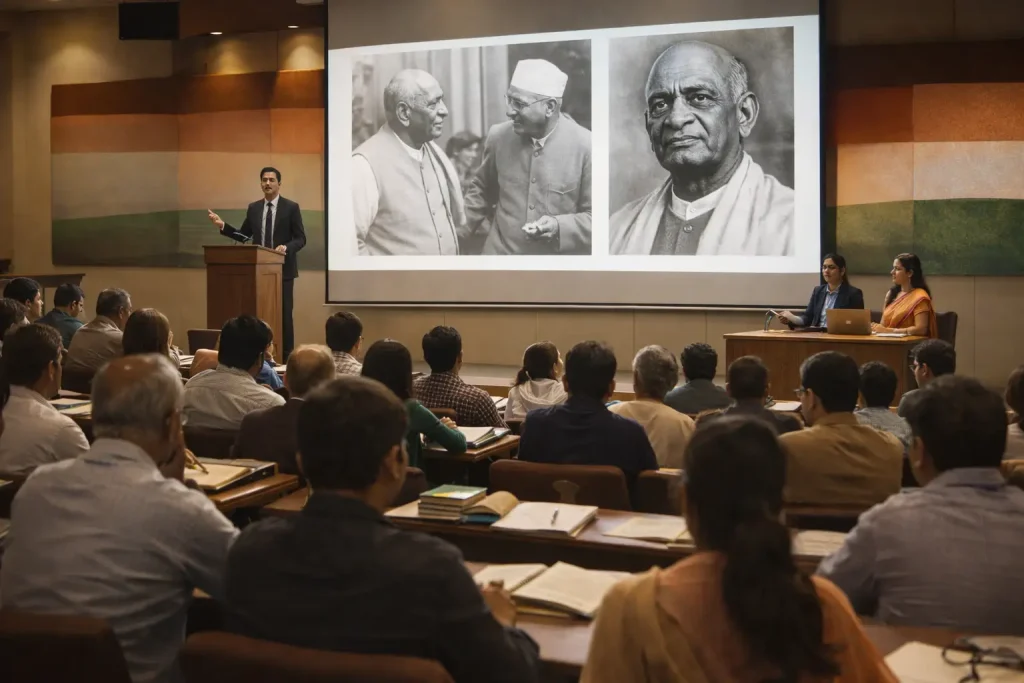
Academic seminars across universities in India increasingly examine Sardar Vallabhbhai Patel not merely as a freedom fighter, but as a foundational architect of modern Indian governance. Scholars in political science and public administration revisit his role as independent India’s first Deputy Prime Minister and Home Minister to understand how he transformed a fragile post-Partition administration into a stable national structure. These seminars focus on his strategic decisions, crisis management abilities, and his deep understanding of institutional discipline during times of political and social unrest.
A central theme in these academic discussions is Patel’s contribution to strengthening the All India Services. Researchers highlight how he defended the continuation of centralized civil services at a time when regional pressures threatened fragmentation. Seminars often analyze his famous address to civil service probationers, where he described them as the “steel frame” of India. Through panel discussions and research presentations, scholars debate how this vision continues to influence India’s bureaucratic ethos and federal balance today.
Another focus of academic conferences is Patel’s approach to national integration. University symposiums explore his negotiation tactics with princely states, comparing his diplomatic firmness with contemporary conflict resolution models. Political historians present case studies on Hyderabad, Junagadh, and other states to illustrate how Patel combined persuasion with strategic resolve. These sessions emphasize that his administrative methods were rooted in realism, yet guided by a broader national vision.
Seminars also explore Patel’s leadership psychology. Management scholars analyze his decision-making style, communication strategies, and ability to command respect without authoritarian excess. His leadership is often contrasted with other global leaders of the twentieth century to understand how he maintained unity during immense upheaval. These discussions position Patel as a case study in crisis governance and institutional rebuilding.
In conclusion, academic seminars play a crucial role in reassessing Patel’s legacy beyond popular narratives. By engaging with archival research, constitutional debates, and administrative case studies, scholars continue to reinterpret his contributions in light of contemporary governance challenges. Through structured academic inquiry, Sardar Vallabhbhai Patel remains a living subject of research, influencing new generations of policymakers and civil servants.