
First Deputy Prime Minister & Home Minister
Administrative Reforms
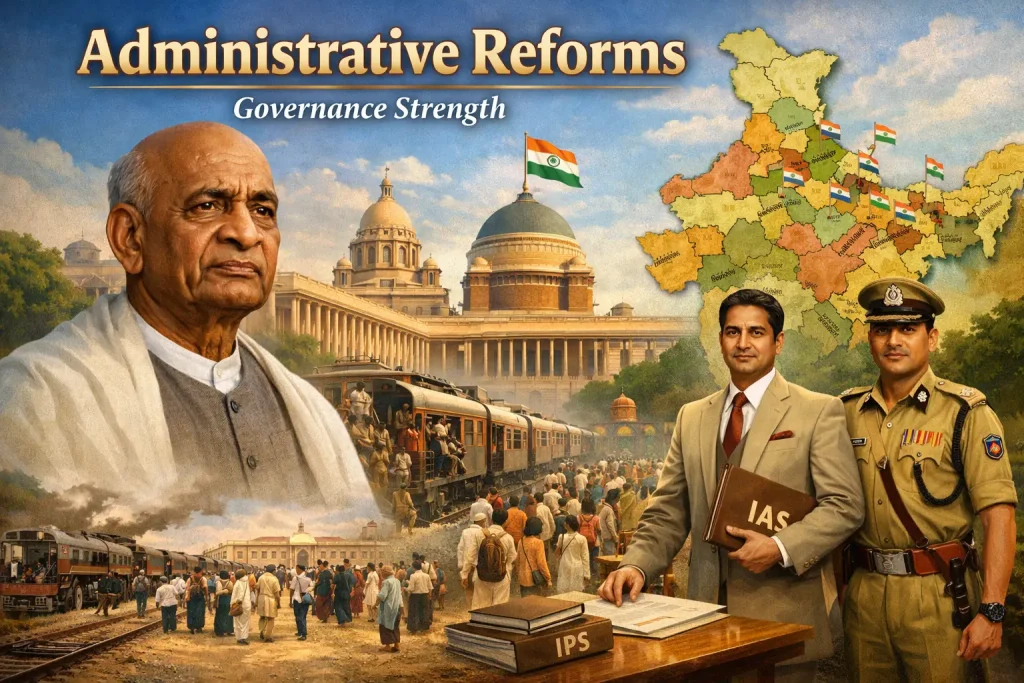
Sardar Vallabhbhai Patel laid the foundation of India’s modern administrative framework after independence. As the country’s first Deputy Prime Minister and Home Minister, he strengthened internal security, restored order during Partition, and ensured smooth integration of princely states. He firmly supported the creation of the All India Services, including the Indian Administrative Service (IAS) and Indian Police Service (IPS), to maintain national unity and efficient governance. His reforms emphasized discipline, accountability, and a strong central structure for stability.
Civil Services Framework
Foundation of IAS
Sardar Vallabhbhai Patel envisioned the Indian Administrative Service as the steel frame of independent India. Designed to ensure administrative continuity, national unity, and disciplined governance, the IAS became the central pillar of policymaking and district administration across states.
Indian Police Service
The Indian Police Service was established to maintain law, order, and internal security in a newly independent nation. Patel strengthened policing structures, ensuring professionalism, integrity, and centralized coordination to protect national stability and public trust.
Civil Services Framework
The trauma of Partition in 1947 created one of the greatest administrative crises in modern history. With the division of territories between India and Pakistan, thousands of experienced civil servants were reassigned, displaced, or forced to migrate. Government offices were abruptly divided, records were scattered, and essential departments such as railways, finance, and home affairs faced severe disruptions. In this moment of uncertainty, Sardar Vallabhbhai Patel, as India’s first Home Minister, played a decisive role in restoring order. He ensured continuity in governance by reorganizing ministries, redistributing responsibilities, and stabilizing provincial administrations. His priority was to prevent administrative paralysis while addressing the humanitarian emergency of refugees crossing borders. Patel emphasized discipline and swift decision-making, encouraging officers to rise above communal tensions and serve the nation impartially. Through careful coordination and firm leadership, he transformed a fractured administrative setup into a functioning governmental system.
Beyond structural reorganization, Patel recognized the urgent need to rebuild morale within the civil services. Many officers were uncertain about their future, divided loyalties, and working in volatile conditions marked by communal violence and mass displacement. Patel addressed them directly, assuring protection, stability, and a clear national vision. He stressed that civil servants were not servants of a regime but guardians of the Republic. His speeches reinforced the idea that integrity, neutrality, and efficiency must guide their conduct in a democratic India. By instilling confidence and emphasizing constitutional responsibility, he cultivated a renewed sense of duty among administrators. This moral reinforcement was crucial in restoring faith in public institutions. Officers were encouraged to work beyond fear and bias, focusing on rehabilitation efforts, relief management, and the restoration of civic services, thereby rebuilding trust between citizens and the state.
Patel also understood that long-term stability required institutional safeguards rather than temporary fixes. He strongly advocated for the continuation and strengthening of the All India Services, believing they would serve as the unifying administrative thread across diverse states. In a time when regional sentiments were strong, he insisted on a centralized framework capable of maintaining national cohesion. By reinforcing recruitment standards, training systems, and service protections, he laid the groundwork for a professional and merit-based bureaucracy. His commitment ensured that governance would remain consistent despite political changes. The restructured bureaucracy became instrumental in integrating princely states, managing refugee resettlement, and implementing early development policies. Through foresight and firmness, Patel not only repaired a disrupted system but also shaped a resilient administrative foundation capable of supporting India’s democratic aspirations.
Rehabilitation of Refugees
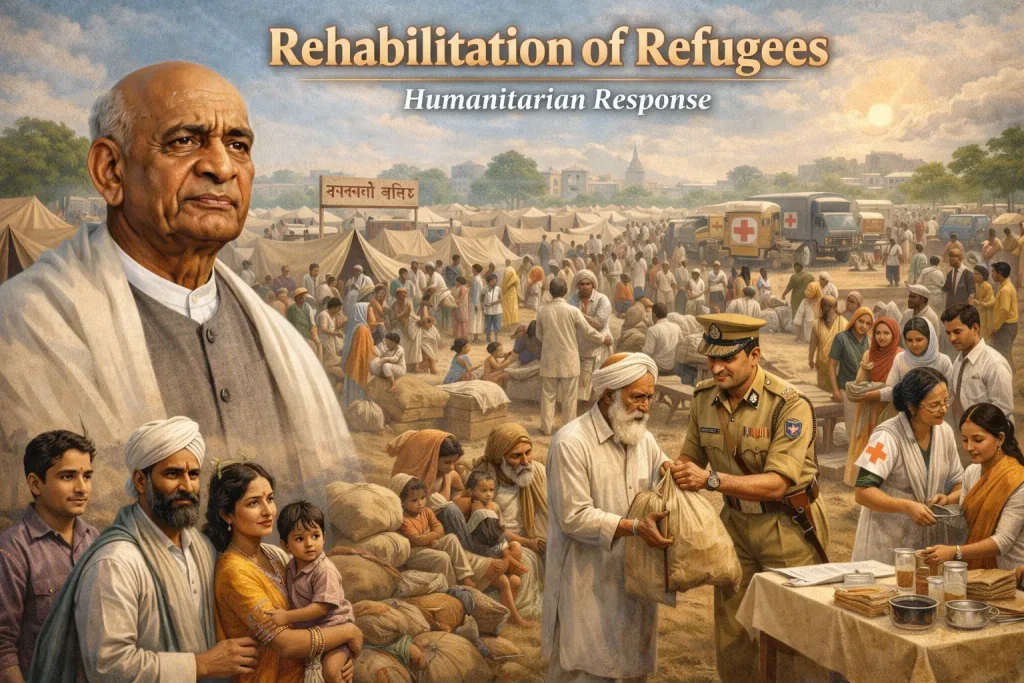
In the aftermath of Partition, millions of displaced families crossed newly drawn borders seeking safety and stability. Sardar Vallabhbhai Patel coordinated large-scale relief operations, establishing refugee camps, restoring law and order, and arranging food, shelter, and medical aid. He worked to resettle refugees through land allocation, employment support, and urban rehabilitation schemes. His administrative resolve ensured structured recovery, helping transform a humanitarian crisis into a managed national rebuilding effort.