
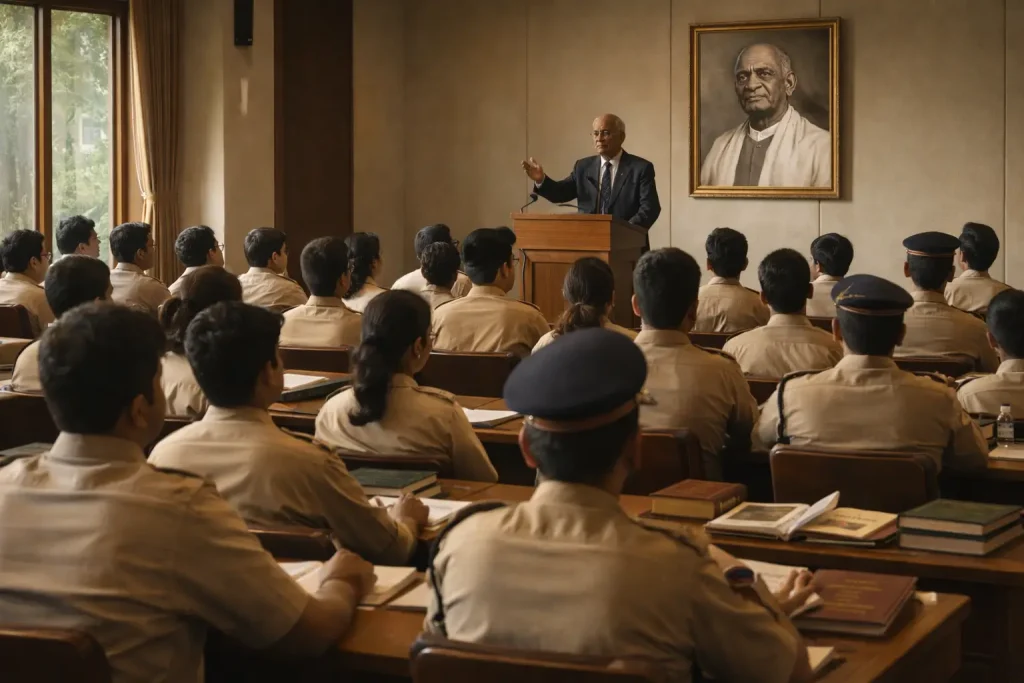
Across civil service academies and public policy institutions, academic seminars frequently revisit Sardar Vallabhbhai Patel’s decisive role in establishing India’s administrative backbone. These scholarly discussions focus on his foresight in safeguarding the integrity of the Indian Administrative Service (IAS) and Indian Police Service (IPS) during the volatile post-independence years. Experts argue that without Patel’s firm intervention, India’s administrative unity might have weakened under regional pressures.
Seminars often begin by contextualizing the chaos of 1947. The division of territories, migration of officials, and administrative vacuum posed immense risks to national stability. Scholars analyze how Patel responded with institutional clarity, insisting that civil servants remain impartial and loyal to the Constitution rather than political parties. His insistence on discipline and accountability became a recurring theme in academic presentations.
Panel discussions further explore Patel’s speeches to probationary officers, emphasizing his belief that civil servants must act as guardians of national integrity. Contemporary researchers draw parallels between his expectations and current debates around bureaucratic neutrality. Through comparative studies, academics assess how Patel’s framework continues to influence recruitment standards, training methodologies, and inter-state administrative coordination.
Workshops within these seminars also examine case studies of early refugee rehabilitation and princely state integration. Researchers demonstrate how civil services under Patel’s leadership executed complex logistical operations efficiently. His administrative philosophy, grounded in realism and ethical responsibility, is analyzed as a model for crisis governance.
Ultimately, academic seminars reaffirm Patel’s relevance in modern policy debates. By situating his administrative reforms within broader constitutional development, scholars highlight how his vision continues to anchor India’s bureaucratic system. His legacy remains central to discussions on governance reform, federal balance, and institutional resilience.